
Is talent nurtured or natural? This question seems to come alive every time a gifted young person steps into the spotlight. History certainly gives us striking examples. Beethoven began composing and performing at age 7. Mozart was writing music at 4 and had already created ten symphonies by the age of 12. With prodigies like these, it’s easy to believe that talent can be something almost instinctive—something a person is simply born with.
That same spark appears in the story of a 7-year-old girl named Anastasia, who stunned her audience by performing the classic Russian folk piece “Valenki.” She stood out instantly—the only child among adults—as she played beside the renowned National Academic Orchestra of Russian Folk Instruments.
The performance opened with the orchestra arranged neatly onstage, each musician in place and holding their instrument. Anastasia, honored with a seat right at the front, seemed almost to lead the entire ensemble. Cradled in her small hands was the powerful triangular Russian balalaika—immediately drawing every eye toward her.
The balalaika itself is a deeply historic instrument. Its roots stretch back to the 18th century, and although it shares qualities with the three-stringed dombra, the balalaika’s signature triangular body sets it apart. Its look alone carries centuries of Russian musical tradition.
The video of Anastasia’s performance begins in a classic orchestral fashion—the conductor raising his arms, giving precise signals with his hands and fingertips. Anastasia opens the work herself, plucking out the first tones of “Valenki” solo for several seconds. Then, one by one, the orchestra folds into her rhythm: strings entering first, followed by double reeds and a well-balanced section of woodwinds. It was a beautifully coordinated opening between Anastasia and the adult musicians.
This particular orchestra is rich with cultural character. Unlike the modern Western symphonic orchestra—defined mostly by woodwinds and varying brass—the Russian folk orchestra draws strength from its distinctive traditional instruments and their unique timbres.
As the song progressed, Anastasia and the orchestra demonstrated just how thoroughly they had rehearsed “Valenki.” The piece flowed with smooth, harmonious movement. After her introduction, the orchestra took charge with a graceful blend of Russian strings, woodwinds, and rhythmic accompaniment. A solo oboist stood out momentarily, weaving through the mix of strings and subtle percussion before the music shifted once again to make room for Anastasia.
When her solo moment arrived, she stepped into it with striking confidence. The ensemble softened their sound, leaving her alone to play a short balalaika solo. She began with bold plucked notes, then quickly broke into fast, energetic phrases entirely on her own.
Listening without watching, one might easily assume an older, highly trained virtuoso was performing. Her tiny arms moved with astonishing precision as she pulled every note from the three strings. Watching her, it was clear how deeply she connected to the music—her focused expression, her natural timing, and the pure joy on her face. The orchestra supported her wholeheartedly, letting her brightness shine at the center of their sound.
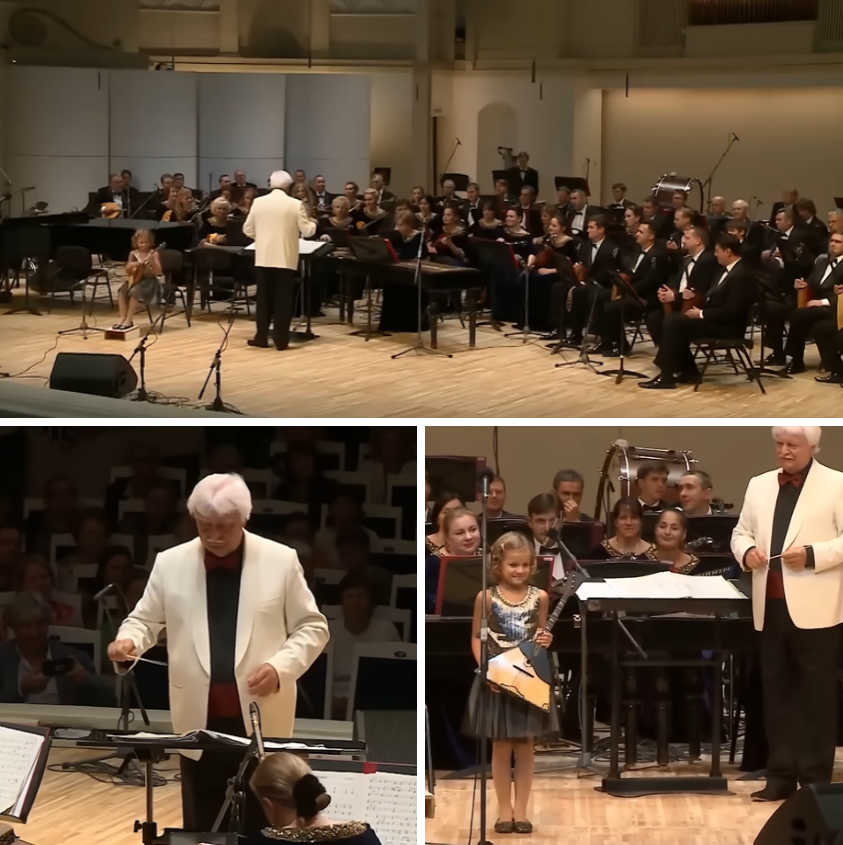
Toward the end, the piece built to a lively conclusion, finishing on a vibrant, satisfying high. Anastasia stood, bowed confidently to the cheering audience, and exited the stage. Their applause said everything—the performance of “Valenki” was electrifying. Anastasia truly earned her moment in the spotlight.
She is, without a doubt, an exceptional talent. That’s why this performance has gained over 12 million views on YouTube and continues to grow — a performance that has also become widely loved and shared across social media.